How to watch VALORANT Champions Shanghai group stage like a pro analyst
Need articles like this for your video? They help promote it on YouTube and Google — order them in the Telegram bot @sat_sit_bot. The bot writes and publishes the articles itself (with your YouTube video embedded) on popular topical websites (no ads). Try it free: 50 articles on us.
· based on the channel VALORANT Champions Tour
VALORANT Champions Shanghai is the 2026 world championship, a 16-team event running from September 24 to October 18 where squads from Americas, CN, EMEA and Pacific compete for the biggest trophy of the year. To follow the group stage properly, treat it as a seeding tournament: watch which teams secure playoff spots early, which ones burn map picks, and which ones survive the elimination matches. The official broadcast hub is VALORANT Esports on X, where schedules, results and bracket updates land first.
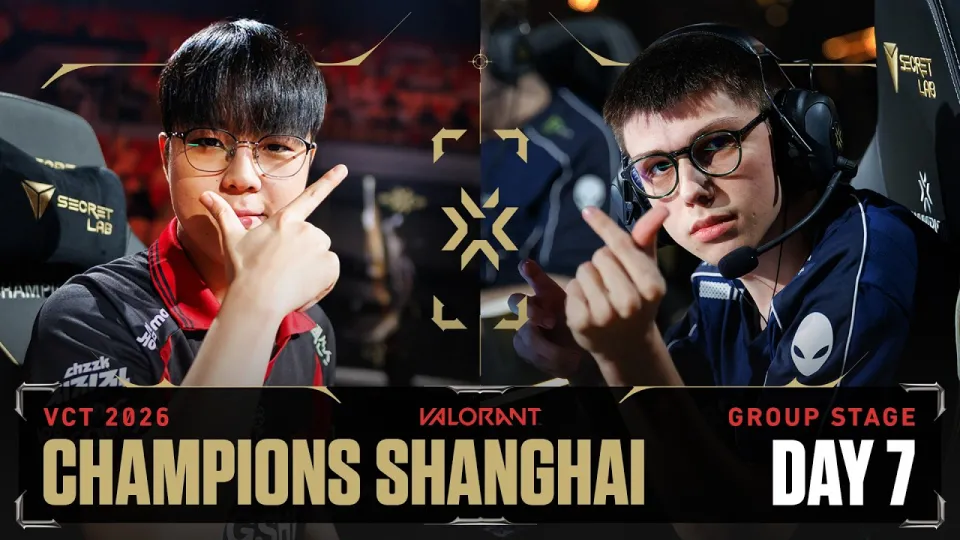
Day 7 of the group stage, published by the VALORANT Champions Tour channel on October 1, is a useful case study because it shows the tournament's real texture: long tech pauses, tight eco rounds, and CN teams under heavy scrutiny from the crowd and the chat.
What the VALORANT Champions Shanghai group stage actually decides
The group stage exists to cut sixteen teams down to the playoff bracket, and every series carries two kinds of stakes: survival and seeding. Sixteen organizations qualified from four regions, and by the time Day 7 aired the picture was already uneven — some teams were playing for a top seed, others for their tournament life.
Three things are worth tracking in any group-stage VOD:
- Map veto patterns. Which team bans the same map every series, and which one keeps forcing a comfort pick even after a loss.
- Pistol and eco conversion. A single lost eco round often decides a group-stage map more than a flashy ace.
- Pace under pressure. Teams that slow down after a timeout usually signal shaky mid-round calling.
Because two different squads won Masters events in 2026, Shanghai is the first event where those champions can be compared directly. The group stage is where that comparison starts, before the bracket makes it unavoidable.
How to read the Day 7 broadcast without spoilers
Day 7 is a long VOD, and the most practical way to watch it is with spoilers blocked and a notebook open. The community timestamp trick — a spoiler-blocking comment with per-map timestamps — is the standard method, though it needs editing when the broadcast inserts a tech pause.
A workable routine:
- Open the VOD and jump to the first map's pistol round rather than the pre-show.
- Watch each map's first six rounds, then skip to the last four. Economy trends show up in those windows.
- Note every timeout and tech pause; they usually follow a momentum swing or a server issue.
- Check the scoreboard after each map to see who topped the server and on what agent.
Tech pauses were the loudest complaint about this broadcast. Long stoppages break viewer rhythm and, more importantly, break player rhythm — a team that was mid-comeback often returns from a pause looking different. When you review a paused match, watch the round immediately after the resume; that is where the real damage shows.
Why CN teams became the group stage's main talking point
The Chinese representatives drew the harshest analysis of the day, and the criticism was specific rather than generic. Viewers pointed to lost eco rounds, thrown 5v2 advantages, and utility usage that collapsed once set strategies were disrupted.
That pattern is diagnosable. Teams that lean on prepared executes often struggle when an opponent forces chaos: default setups break, mid-round communication shortens, and players default to individual duels. The fix is not a new composition but a different decision tree — who calls when the execute fails, and which player is allowed to improvise.
There is a fair counterargument too. The CN region's depth was questioned in chat, with viewers arguing that stronger teams from other regions missed the event entirely. That is a structural debate about qualification slots, not a verdict on individual players. Both things can be true: a region can be weaker at the top and still deserve its spots.
One more note from the broadcast: a Yoru clone momentarily read as a teammate holding site, which is exactly the kind of confusion that separates a clean read of the minimap from a lost round.
The players and moments that define this group stage
Individual form is the fastest way to judge a group stage, because team macro takes weeks to evaluate while aim and positioning are visible immediately. The Day 7 chat singled out veteran riflers for carrying impossible rounds, and that tracks with how the tournament has gone: experience holds up when the bracket tightens.
Watch for these signals in any match:
- Entry success rate. A duelist who wins first contact over 55% of the time tilts the whole map.
- Sentinel utility value. Killjoy and Cypher setups that force rotations are worth more than raw kills.
- Clutch frequency. Players who win 1v2s repeatedly are usually reading the opponent's economy, not guessing.
The gap between a group-stage star and a playoff star is usually composure, not mechanics. Day 7 offered both: clean individual highlights and rounds thrown by hesitation.
Common viewer questions about the Shanghai group stage
Most confusion around the event comes down to format and scheduling rather than gameplay. The group stage is not a round robin where every team plays everyone; it is a bracket that produces playoff seeds, which is why some series matter far more than others.
The second recurring question is about broadcast quality. Multiple tech pauses in one day are unusual even for a major, and they generate two reactions: frustration from viewers and concern for players who lose momentum. Neither reaction is wrong.
The third is regional strength. Debates about which region deserved more slots are perennial, and they rarely resolve inside a single event. The only real answer is head-to-head results, which the playoff bracket will provide.
Finally, viewers ask how to catch matches live. The VALORANT Champions Tour streams on Twitch at https://www.twitch.tv/valorant, with clips and highlights distributed across the official social channels.
Useful links
- Official VALORANT Esports news and schedule: https://www.valorantesports.com
- Live updates on X: https://x.com/valorantesports
- Facebook: https://www.facebook.com/ValorantEsports/
- Instagram: https://www.instagram.com/valorantesports/
- TikTok: https://www.tiktok.com/@valorantesports
- Twitch: https://www.twitch.tv/valorant
What to take away from the Shanghai group stage
The group stage is doing its job: it has separated teams with real mid-round structure from teams that only look good on prepared executes. Tech pauses and regional debates will dominate the conversation, but the bracket is the only judge that matters. Follow the official VALORANT Champions Tour channel for the full VOD library, and check VALORANT Esports on X for the playoff schedule before the next match day.
Key takeaways
- VALORANT Champions Shanghai runs September 24 to October 18, with 16 teams from Americas, CN, EMEA and Pacific fighting for the 2026 world title.
- The group stage is a 16-team bracket that decides who advances to the playoff bracket in Shanghai.
- Day 7 of the group stage is the VOD published by the VALORANT Champions Tour channel on October 1.
- Two different teams won Masters events in 2026, so Shanghai is the first true tiebreaker of the year.
- Viewers flagged repeated tech pauses in the Day 7 broadcast, plus criticism of CN teams losing eco and 5v2 rounds.
Questions & answers
How many teams play in the VALORANT Champions Shanghai group stage?
Sixteen teams qualified from four regions: Americas, CN, EMEA and Pacific. They compete across the group stage to determine which squads advance to the playoff bracket and in what seeding order.
Why were there so many tech pauses during Day 7?
The broadcast experienced repeated technical stoppages, which viewers noted as unusually frequent for a major. Pauses disrupt player momentum as well as viewer flow, so the round immediately after a resume often reveals which team handled the break better.
Are CN teams really the weakest region at the event?
Viewers criticized CN squads for losing eco rounds and 5v2 advantages, and for struggling once set strategies broke down. That is a fair critique of specific rounds, but regional strength is a broader question about qualification slots that only head-to-head playoff results can settle.
Where can I watch VALORANT Champions Shanghai live and on demand?
Live matches stream on Twitch at https://www.twitch.tv/valorant, and full VODs are published on the VALORANT Champions Tour YouTube channel. Schedule and bracket updates appear on the official VALORANT Esports site and the @valorantesports accounts.
Source: VALORANT Champions Shanghai — Group Stage — Day 7 · Markdown version